
Search Chowan County Court Records Online
The main online channel for Chowan County court records is the North Carolina eCourts Portal. The Portal gives public access to Smart Search, Search Hearings, Make Payments, and NC Judgment Search. It is statewide, so a Chowan County search works best when the location filter is set to Chowan County rather than all counties. The Portal also requires JavaScript, cookies, and repeated CAPTCHA checks, so a stalled search may be a browser or session issue instead of a missing case.
Smart Search is the place to start for case records and case information. Search Hearings is better when the need is a court date, courtroom, hearing type, or judicial officer. Judgment Search is a separate index for North Carolina judgments, and Make Payments is limited to eligible payable matters. For copy work, certified documents, divorce judgments, older paper files, or background checks, the Chowan County Clerk of Superior Court remains the local records office.
- Open eCourts Portal and choose Smart Search for case records or Search Hearings for calendars and dockets.
- Enter a record number or a party name in the Portal's Last, First Middle Suffix format.
- Open Advanced Filtering Options when the name is common, then set the location to Chowan County.
- Use case type, case status, and file-date filters when the case number is not known.
- If the online result is incomplete, contact the Chowan Clerk of Superior Court for terminal access, paper-file review, or copies.
The eCourts Portal homepage is one of the successful source images for this page.
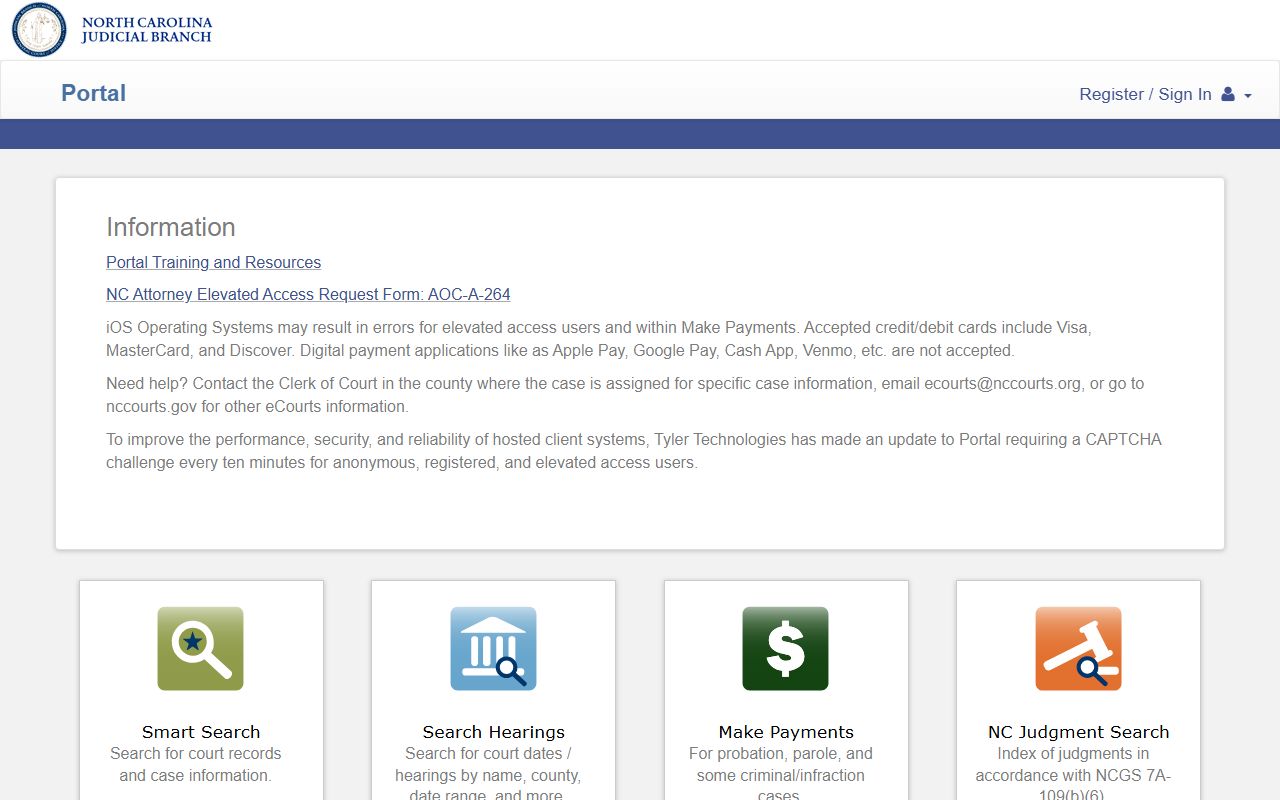
That Portal view matters because Chowan County court records are reached through statewide tools rather than a county-built case search.
Chowan County Court Records Search Fields
The Smart Search form supports a quick search by case number or name, but the useful Chowan County court records filters sit in the advanced options. A party search can use name, date of birth, and other identifiers when they are public and appropriate. A case search can use location, case type, case status, and file date. The research capture did not verify every dropdown option, so the table reflects the visible fields and the Portal's stated format rules.
| Field Label | Type | Required | Notes / Format |
|---|---|---|---|
| Record Number or Name | Text | Yes for basic search | Use Last, First Middle Suffix for names; case-number wildcard needs at least four characters. |
| Last Name / First Name | Text | Yes in name mode | Name wildcard uses at least three last-name characters and one first-name character with an asterisk. |
| Middle Name / Suffix | Text or dropdown | No | Optional fields help separate similar names. |
| Filter by Location | Dropdown | No | Select Chowan County to avoid statewide results. |
| Search by | Option control | No | Party Name, Nickname, Business Name, and Sounds Like are visible search modes. |
| Date of Birth From / To | Date | No | Used as a party filter when a lawful public search needs more precision. |
| Case Type / Case Status | Dropdown | No | Options were visible as filters, but not fully exposed in static capture. |
| File Date Start / End | Date | No | Useful when the approximate filing period is known. |
Types of Chowan County Court Records
Chowan County court records are not one file type. They come from Superior Court, District Court, magistrate functions, the Clerk of Superior Court, and statewide indexes. Superior Court is the primary trial court for felony criminal matters and higher civil matters. District Court handles many misdemeanors, infractions, traffic, domestic, juvenile, and small claims matters. Magistrates are important for initial process, warrants, small claims steps, and some payment access at the courthouse.
The record type controls both where to search and what can be released. Divorce judgments are court records held by the clerk in the county of divorce. Marriage licenses are not court records in Chowan County; those belong to the Register of Deeds. Booking records are sheriff records, not court files. Returned warrants and criminal summonses may become public court records unless sealed, while active or unserved warrants may not appear in an online search.
- Criminal court records can show charges, hearings, pleas, motions, dispositions, sentences, fines, costs, and probation conditions.
- Civil court records can include complaints, answers, motions, orders, judgments, liens, partitions, foreclosures, and small claims files.
- Family and divorce records can show public docket data, but child, financial, and safety details may be restricted.
- Estates and special proceedings include wills, inventories, letters, guardianship matters, foreclosures, and clerk proceedings.
- Traffic and infraction records are court records in District Court, separate from the NCDMV driver record.
- Judgment records may be searched through the Portal's judgment index when the matter has been indexed under North Carolina rules.
For statewide court-copy guidance, the NC Judicial Branch obtaining court records help topic is another assigned source image.
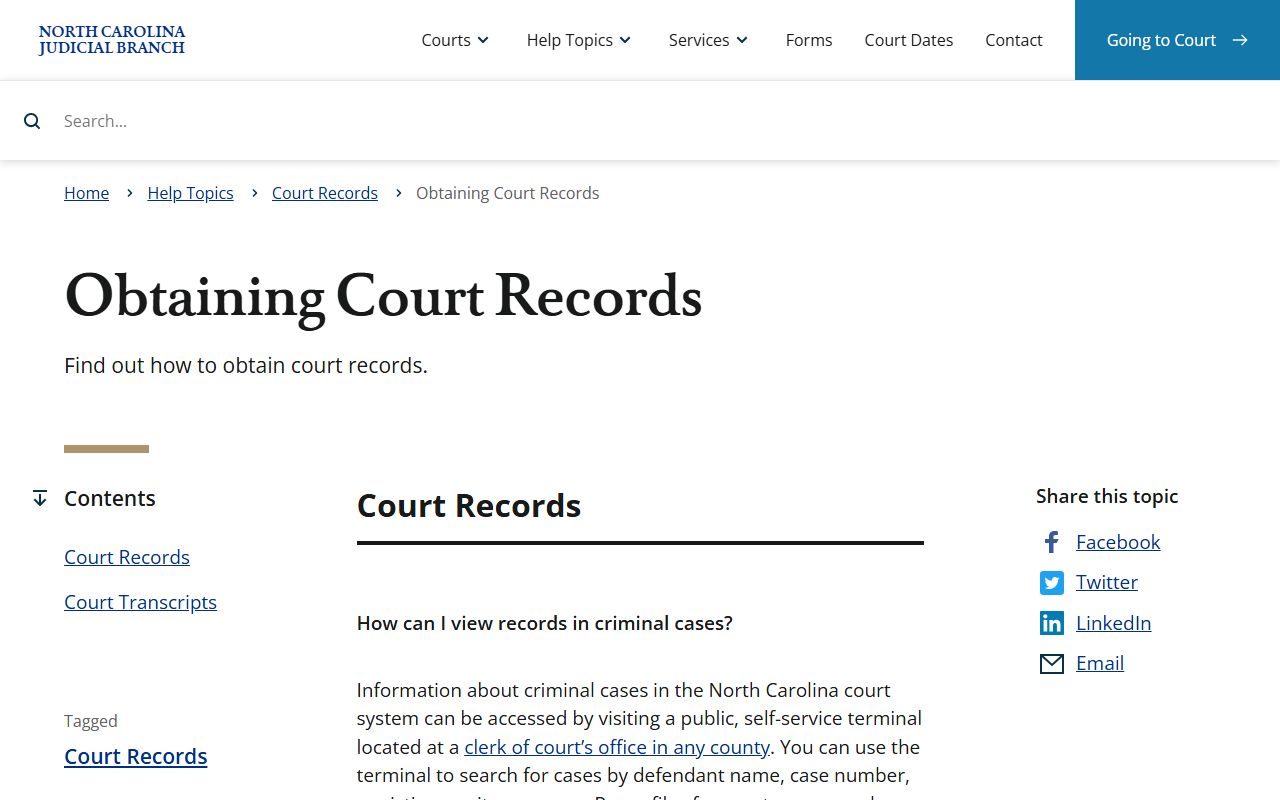
That help topic supports the Chowan County fallback path: use Portal when it works, then use public terminals or the clerk's office for paper files and copies.
What Chowan County Court Records Show
A Chowan County court record usually starts with identifying data and then adds events as the case moves. The online Portal may show case information and documents when available, but the research did not verify a complete clicked sample case. The safer reading is that online results can identify public case metadata, hearing data, and available documents, while the official paper file and certified copy process still run through the Clerk of Superior Court.
| Field | What It Shows |
|---|---|
| Case number or record number | The unique court identifier used for Portal, terminal, clerk, and payment searches. |
| Location and court division | Chowan County plus the court path, such as Superior Court, District Court, estates, or special proceedings. |
| Case type and filing date | The matter category and the date range used to narrow searches. |
| Parties | Names such as plaintiff, defendant, petitioner, respondent, estate, business party, or attorney. |
| Docket and hearing data | Hearing date, hearing type, courtroom, judicial officer, attorney, and related event entries. |
| Financial data | Costs, fines, payment eligibility, judgment amounts, and court-cost entries when public. |
| Documents and orders | Available online documents or paper-file items such as motions, orders, judgments, and notices. |
| Restrictions | Sealed, expunged, juvenile, mental health, and personal-identifier limits that affect public display. |
Public Access to Chowan County Court Records
North Carolina public access has two layers for Chowan County court records. G.S. 132-1 defines public records broadly for documents and data made or received in public business. Court records also have a court-specific rule in G.S. 7A-109, which requires clerks to keep records, dockets, files, and indexes and makes those clerk records open to inspection during regular office hours unless another law blocks access.
The practical result is simple. Ordinary Chowan County court records can often be searched online, but the Clerk of Superior Court is still the legal custodian for court files. Requests for court-document copies should go to the clerk in the county where the case was filed, not to the Judicial Branch administrative public-records request form. Agency records, such as sheriff reports or jail booking material, go to the sheriff or agency that created them.
Note: Certified copies, background checks, and older paper files should be verified through the Chowan Clerk of Superior Court.
The assigned image from G.S. 132-1 anchors the broad public-record definition used in North Carolina.
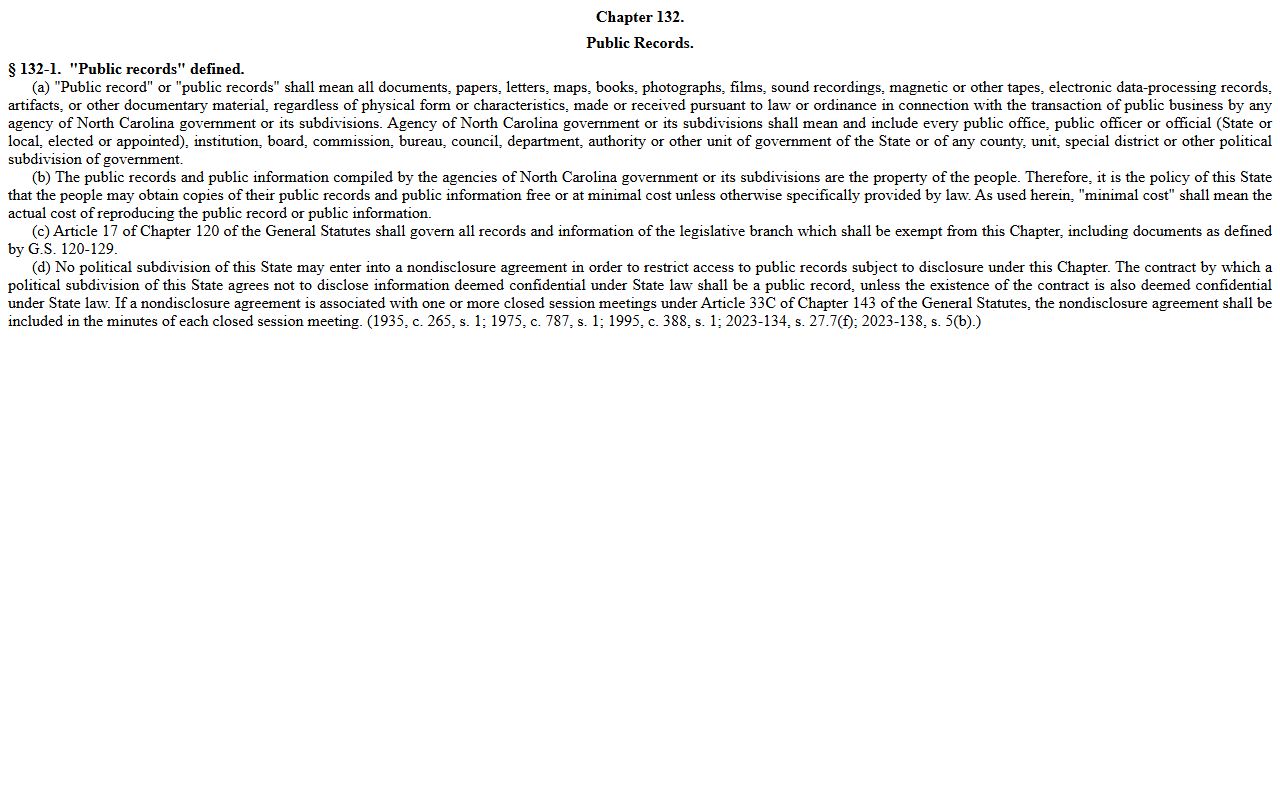
That statute explains why public access is broad, while the clerk statute explains why court records still follow court-specific custody rules.
Restricted Chowan County Court Records
Not every Chowan County court record is open in the same way. Juvenile delinquency, abuse, neglect, and dependency matters are restricted. Adoption records are confidential. Mental health proceedings can involve protected health data. Expunged cases are removed from ordinary public access, and sealed records are hidden by law or court order. Personal identifiers such as Social Security numbers, financial account numbers, protected minor details, and sensitive victim or witness details may be redacted.
North Carolina expunction rules are controlled by Chapter 15A Article 5, and eligibility depends on the charge outcome, offense type, age, prior record, waiting period, and whether sentence or payment terms are complete. A person who believes an expunged Chowan County matter still appears should contact the clerk in the county of filing with the expunction order. General public searches should not expect open access to juvenile or sealed matters.
The court-record inspection rule in G.S. 7A-109 is also assigned as an image source for this page.
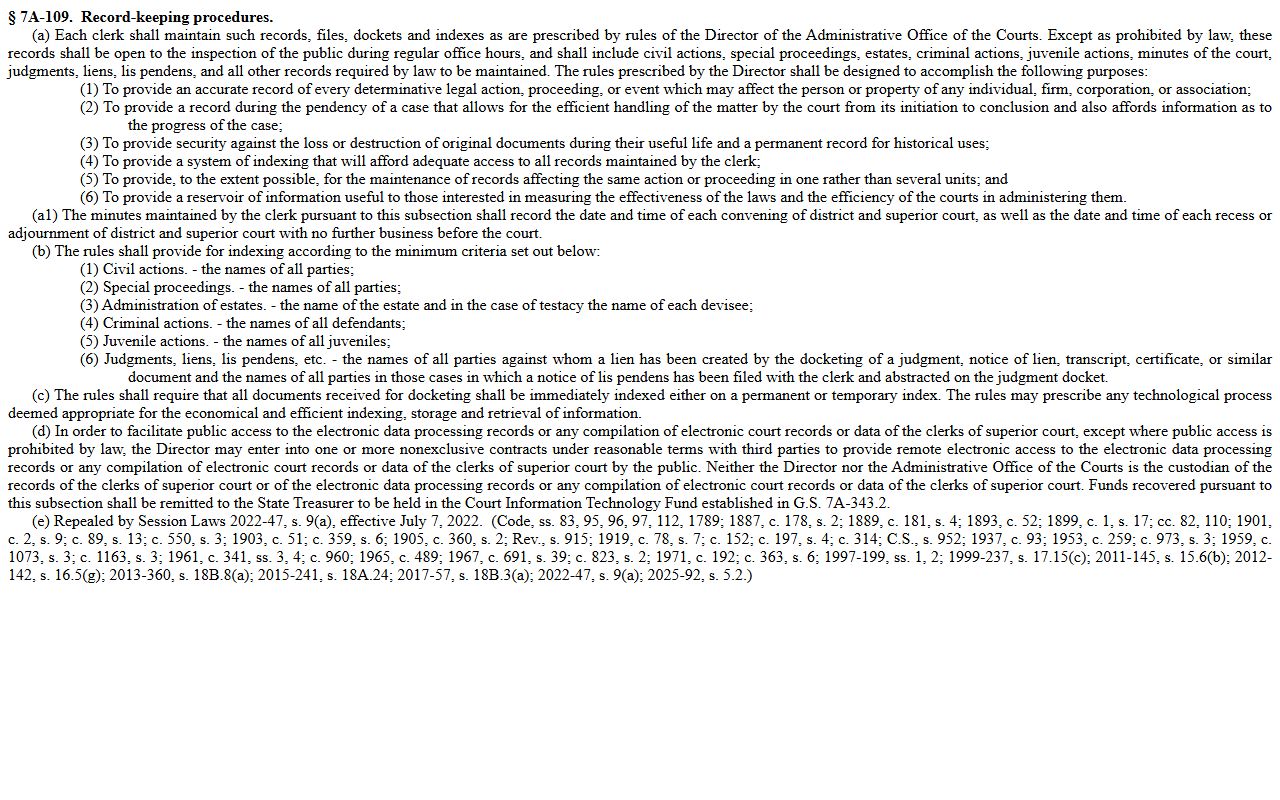
The clerk statute is the reason courthouse inspection matters even when eCourts is the first search path.
Chowan County Clerk Record Requests
For Chowan County court records that need official handling, use the Clerk of Superior Court at the courthouse. Public self-service terminals at clerk offices can be used for criminal case searches by defendant name, case number, or victim and witness name. Civil, special proceeding, and estate information can also be accessed at terminals, and paper files may be viewed by visiting the clerk in the county where the case is located. Copies can be made for a fee.
Chowan County Clerk of Superior Court
101 S Broad St
Edenton, NC 27932
Mailing: PO Box 588, Edenton, NC 27932
(252) 368-5000
Monday-Friday, 9:00 a.m.-5:00 p.m.
Direct division lines are useful when the case type is known. The Criminal Division is (252) 368-5002, Civil Division is (252) 368-5003, and Estates/Special Proceedings is (252) 368-5004. Payment by mail must be money order or certified check payable to Chowan County Clerk of Superior Court; in-person payment may include cash, credit or debit card with processing fees, money order, or certified check.